
Start with the path, not the machine
Before you place a soft-serve or frozen yoghurt machine, map the full path from stock delivery to serving. In a busy restaurant, dessert service often happens beside hot kitchen work, drinks, till points and takeaway packing, so the station must avoid crossing traffic. If staff need to step around a till queue or squeeze past a dishwasher door every time they serve a cone, service slows down and spills become more likely.
In practice, the best flow usually starts with dry stock on one side, mixes and cones in the middle, and serving on the customer-facing side. Keep the machine close enough to the team for easy topping up but not so close to heat that the product softens too quickly. In Durban, where humidity can be high for most of the year, it also helps to keep the surrounding counter dry and well ventilated so packaging does not go limp.
- Allow a clear staff walkway of at least 900 mm where possible.
- Keep cones, cups and toppings within one reach zone.
- Separate incoming stock from the point where finished desserts are handed over.
Build a station that works in a small footprint
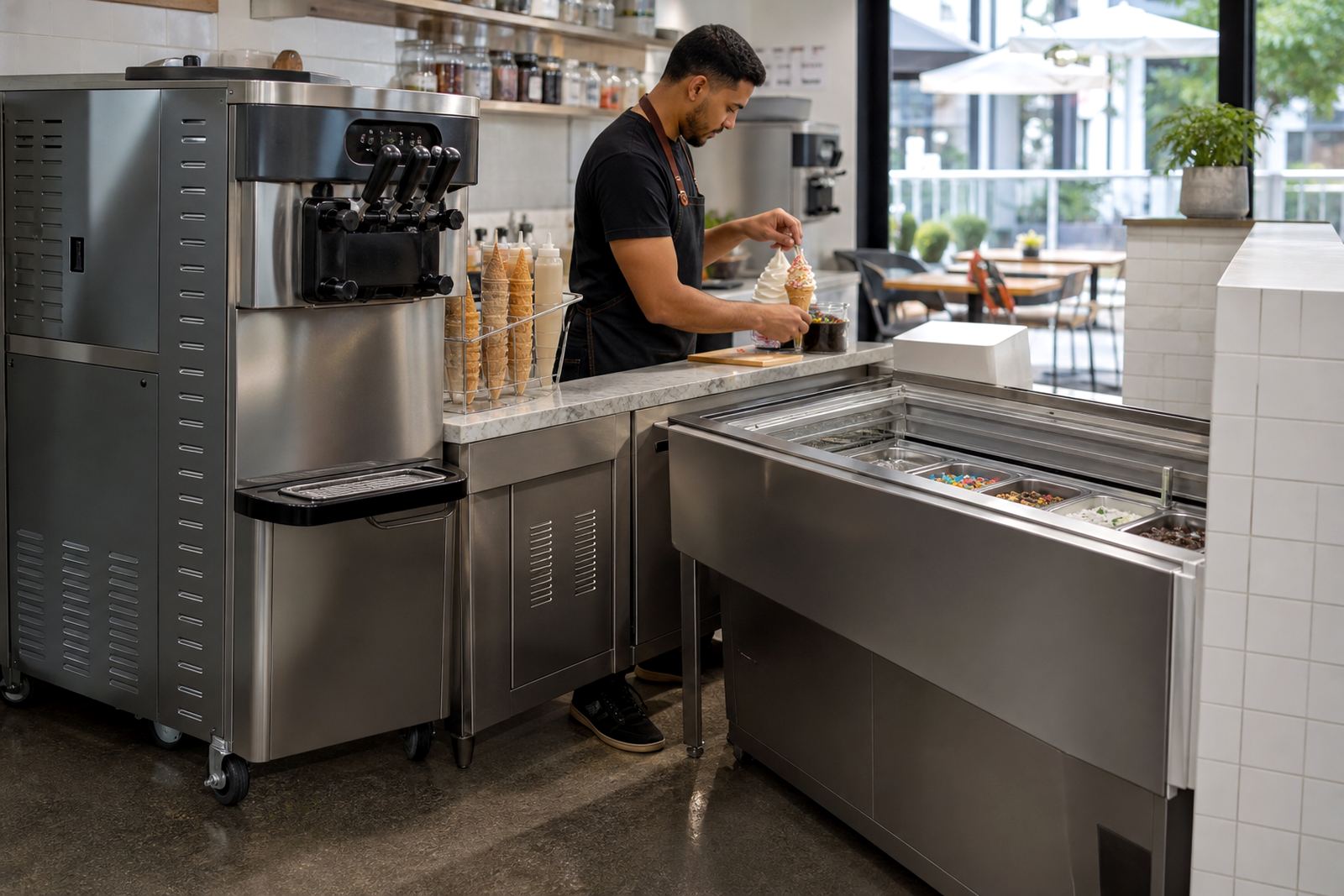
Many restaurants do not have the luxury of a separate dessert counter. In those cases, the station should be designed like a compact work cell, not a display feature. A single operator should be able to pour mix, check the machine, grab a cone and hand over the dessert without turning around three times. That saves seconds on each order, which adds up during weekend service or school holiday rushes.
For cafes and kiosks in places like Umhlanga, Pietermaritzburg or central Durban, a narrow counter can still work if the equipment is arranged in sequence. Put the machine where the operator can watch the front and the service pass at the same time. Leave enough space for a small sanitising area, because sticky residue on the counter becomes a problem quickly when sugar and dairy are involved.
- Use wall shelving above the prep area for dry cones and backup mixes.
- Store cleaning cloths and sanitising supplies in a marked lower cabinet.
- Keep a small drip tray area between the machine and the handover point.
Separate the sweet line from the hot line
Dessert flow fails when the station sits too close to the hot section. Steam from grills, fryers and dishwashers can create extra heat and moisture around the machine, while grease in the air affects cleanliness. A frozen dessert station should feel calm and controlled even when the rest of the kitchen is busy. That does not mean it must be isolated completely, but it should not compete with plated mains or final garnishing.
If your restaurant serves desserts after lunch and dinner, place the station where staff can switch into dessert mode without moving through the full kitchen. This is especially useful where one team handles both service and prep. A clear split between savoury work and dessert assembly reduces mistakes, keeps the serving counter cleaner and makes operator training much simpler.
- Do not place the machine directly beside ovens, dishwashers or open fry stations.
- Keep topping containers covered and labelled.
- Use a defined handover point so plated meals and dessert orders do not cross paths.
Plan for power cuts and peak trading
Load-shedding changes how every food business plans service. A dessert station should not depend on guesswork, especially when the dinner rush is coming and the lights have just gone off. For restaurants using frozen yoghurt or soft-serve equipment, check that the machine location is close to a stable power source and that the backup plan is simple enough for a busy team to follow. If the setup changes every time the power returns, staff will lose time and product can be wasted.
Seasonal demand matters too. In coastal areas and holiday towns, dessert sales rise sharply during warm weather and school breaks. That means the station must be ready for larger mix volumes, extra cones and faster turnarounds. A practical setup includes enough storage for peak stock, a routine for mix calibration and a clear process for startup checks at the beginning of each shift. The more repeatable the process, the less likely you are to get uneven texture or a stop-start service line.
- Check that the station can run through a full service period with minimal interruption.
- Keep a written opening checklist for the team on duty.
- Store spare seals and parts on site if the machine is used daily.
Make cleaning part of the flow, not an afterthought
A dessert station can look tidy at the start of service and still become messy by closing time if cleaning is not built into the layout. The best stations make wipe-downs easy. That means smooth counter surfaces, easy access to the machine panels and enough space for a bucket, cloths and sanitising supplies. When cleaning is awkward, it gets delayed, and that is when sugar, dairy and crumbs start to build up.
For cafés, kiosks and restaurants that trade long hours, a short mid-shift clean is often better than waiting until the end of the day. That helps with hygiene and keeps the machine looking ready for customers. It also supports more accurate startup and shutdown routines, since operators are working from a clean surface each time. A good layout should let one person wipe, rinse and reset without holding up the rest of the service team.
- Keep a dedicated cleaning point close to the station.
- Use removable containers where possible for toppings and mix accessories.
- Schedule a deeper clean before busy weekends and after holiday peaks.
A Durban example that shows the difference
Consider a family restaurant in Durban that serves lunch, dinner and takeaway from the same counter. The first version of the dessert station was tucked between the drinks fridge and the pass. Staff had to cross the same space used for plates, sauces and card payments. During peak periods, orders got mixed up and the machine area stayed damp from constant foot traffic. After a layout review, the station was moved to a quieter end of the counter with cones, mixes and sanitising supplies arranged in sequence. The change was simple but the impact was immediate.
Service became faster because the operator no longer stepped around other tasks. Stock checks were easier, the machine stayed cleaner and the team could prepare desserts without blocking the main counter. For businesses in Springfield Park, Johannesburg, Pretoria, Cape Town or Gqeberha, the lesson is the same: even a small shift in flow can improve service, reduce waste and make training easier for new staff.
When a dessert station supports the rest of the restaurant instead of fighting with it, the whole team works better. That is what good flow should do.