

Home / Projects / Phoenix Food Court

Projects

Phoenix Food Court

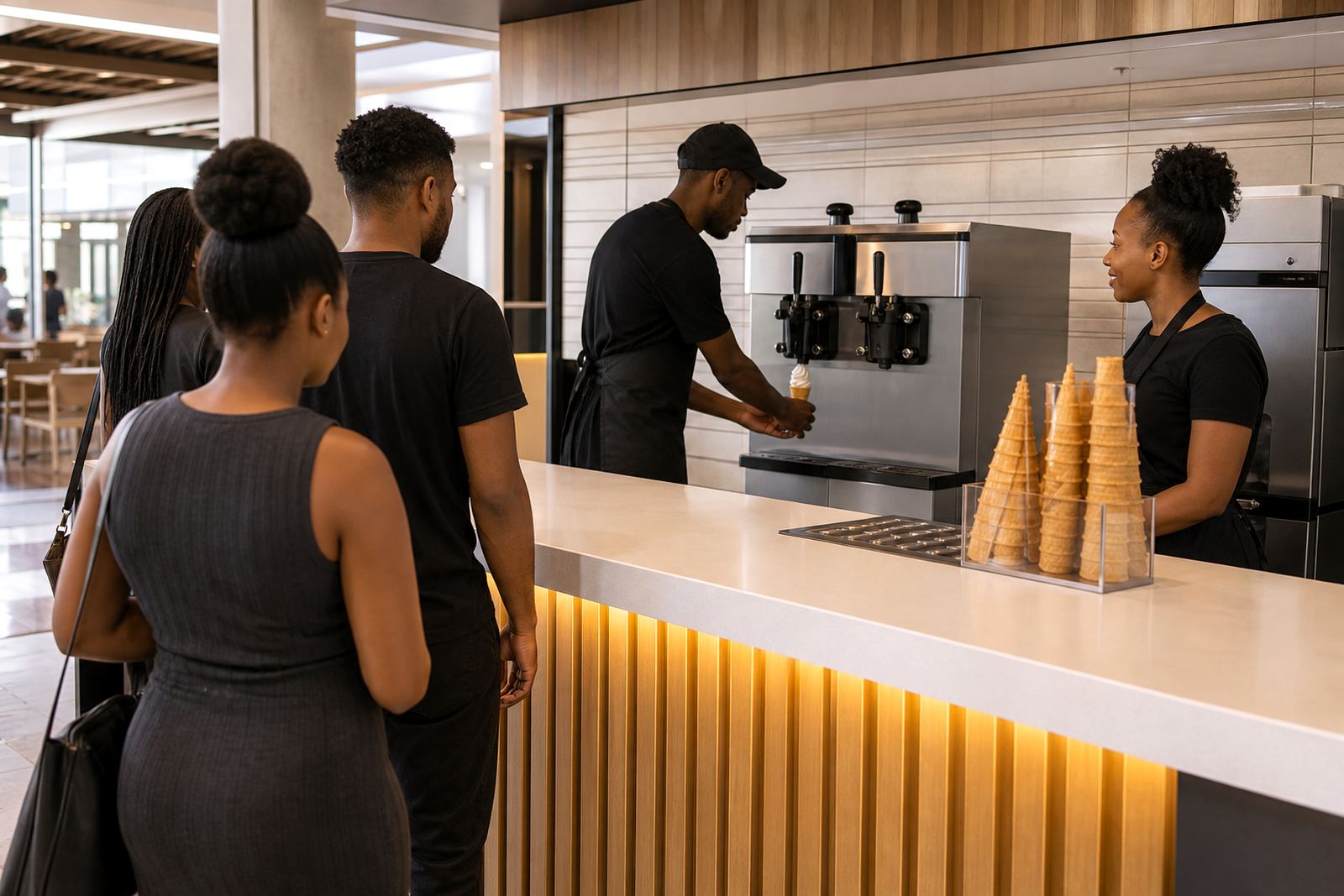
A Phoenix food court needed a higher-output frozen dessert station that could keep up with lunch peaks and weekend trade without creating cleaning hassles. SnoCream supplied and commissioned a practical set-up that suited the site, the staff, and the pace of a busy KwaZulu-Natal trading floor.

Phoenix Food Court

The brief from a busy Phoenix food court

The client was a food court operator in Phoenix, Durban, looking to add soft-serve and frozen yoghurt to the menu for walk-in customers and takeaway traffic. The aim was straightforward: faster service, a cleaner counter, and a machine that could handle spikes after school, on pay weekend, and during warm spells when dessert sales pick up quickly.

They needed a unit that would suit a compact service area, be simple for rotating staff to use, and keep product quality steady through a long trading day. The site also had to manage power interruptions and the general pressure that comes with a food court where several traders share the same customer flow.

From the first discussion, the brief focused on output, hygiene, and training. The client wanted a setup that would not need constant tinkering, and one that could be kept in service by a small team with clear cleaning routines and easy daily checks. That shaped the machine choice and the support plan.

Site constraints and practical planning

Like many food court sites in Durban, the space was tight and the working counter had to stay clear for queue movement, till access, and cup storage. There was limited back-of-house room, so the equipment layout had to allow for stock handling without blocking the pass area. We also worked around the existing counter height and the power points already on site.

The client was concerned about summer humidity and how that affects mix storage, cone stock, and cleaning frequency. There was also the question of load-shedding. The machine had to be supported by a sensible operating routine so the team could restart safely after an outage and protect product quality during any stop-start trading.

  • Compact footprint for a food court counter
  • Simple controls for shift staff
  • Easy access for daily sanitising
  • Practical placement for mix, cones, and drip trays
  • Operating guidance for outage recovery and cold-start checks

What SnoCream supplied and fitted

We supplied a high-output soft-serve machine suited to food court service, together with frozen yoghurt mix, serving cones, and the accessories needed for day-to-day use. The machine was selected for steady portion control and dependable recovery between serves, which matters when customers arrive in short bursts and expect quick turnaround.

Our technical team handled the installation and startup commissioning. That included positioning, basic power checks, mix setup, initial calibration, and a full test run before handover. We also checked the cleaning access around the drip tray and outlet area so the team would not struggle during the end-of-day washdown.

During the handover we covered the daily start-up routine, how to manage product consistency, and what signs to watch for if output begins to drift. The operator training was kept practical and short. The team needed to get comfortable with the machine quickly, not sit through a long lecture.

  • Machine installation and startup commissioning
  • Operator training for day shift and relief staff
  • Mix calibration for consistent serve texture
  • Sanitising supplies for routine cleaning
  • Season prep checks before hotter trading periods

Timeline from order to handover

The project ran over three weeks from confirmation to final commissioning. Week one covered the site review, equipment sizing, and the operating plan. Week two was used for supply coordination, stock planning, and preparation for installation. Week three covered delivery, fitting, test runs, and training with the on-site team.

That schedule worked well because the client wanted the station live before a busy trading weekend. It also gave enough time to make small adjustments to the counter arrangement and confirm stock storage positions. Nothing was rushed, and that helped reduce the usual first-week teething issues.

We stayed in contact through the process so the client could ask questions about cleaning intervals, restocking and daily switch-on procedures. Having those points settled before opening made the first service period much calmer, especially for the supervisors managing more than one outlet in the court.

Results during lunch and weekend peaks

Once the station went live, the client saw better serving speed during the lunch rush and less congestion at the counter. The machine kept pace with short bursts of demand, and the team found it easier to maintain a consistent texture through the day. For a food court, that consistency matters because customers often decide at the counter whether to add dessert to their meal.

The operator feedback was that the unit was straightforward to run and easier to keep clean than the previous set-up they had used for trial service. Because the staff had clear training and a cleaning routine, the machine was ready quicker each morning and settled back into service more predictably after rest breaks. That reduced waste and cut the chance of avoidable downtime.

  • Shorter queues at peak times
  • More stable product texture through the shift
  • Cleaner daily shut-down and restart routine
  • Better fit for weekend trade and family traffic
  • Less staff guesswork around calibration and cleaning

What we would repeat on another Phoenix site

If we were doing the same kind of project again in Phoenix or another busy Durban suburb, we would keep the same approach: measure the counter properly, plan the power and stock flow early, and train the operators before the first trading weekend. That combination gave the client a practical result instead of a complicated set-up that only works on paper.

We would also keep the service plan simple. In a food court, things move fast and the team changes from shift to shift, so the support has to be easy to follow. Preventive maintenance, seal and parts checks, and scheduled deep cleaning all help protect output when trade is steady. It is better to sort those details before the busy season than to fix them mid-service when customers are already lining up.

For a site like this, the winning formula is not fancy. It is a reliable machine, the right mix, proper training, and a service team that understands Durban conditions. That is what made this installation work well for the client, and it is the same method we would use again for another food court or kiosk that needs dependable frozen dessert sales.

Key facts

LocationPhoenix Food Court, Durban, KwaZulu-Natal
Project typeHigher-output frozen dessert station for lunch and weekend peaks
Machine scopeSoft-serve machine with frozen yoghurt capability
Support includedInstallation, commissioning, training, calibration and cleaning guidance
Timeline3 weeks from confirmation to handover
Operating focusFast service, easy cleaning, steady output during busy trade

What our Soft-Serve Machine customers say

Verified Google reviews

Questions we get asked

Can this kind of machine handle busy lunch periods?

Yes. The set-up was selected for shorter queues, quick recovery between serves, and steady output during peak traffic.

Was the site training practical for shift staff?

It was. The handover focused on daily start-up, cleaning, calibration checks, and what to do after a power interruption.

Would this work in another Durban food court or kiosk?

Yes. With the right counter space, power planning, and stock flow, the same approach works well for similar high-traffic sites.

Planning something? Send the team a message.

Contact form